
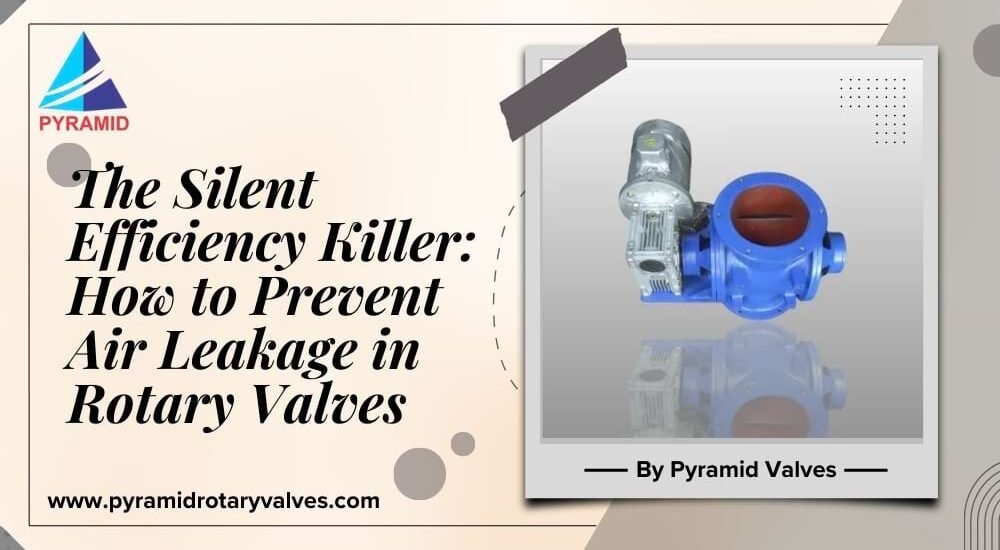
In any pneumatic conveying or dust collection system, the Rotary Airlock Valve serves one primary purpose:
to pass material from one pressure zone to another while maintaining a vertical seal.
When this seal fails, “blow-back air” travels upward into your hopper or silo.The result? Material bridging, reduced feed rates, and increased energy consumption. At Shree Techno Engineers, we design the Pyramid range to combat these specific pressure losses through precise engineering.
1. The Science of Rotor Clearances
The most common cause of leakage is excessive clearance between the rotor tips and the housing. While some expansion room is needed for high-temperature coal or ash, too much gap allows high-pressure air to escape.
- The Standard:
For ambient temperatures, we maintain a precision clearance of roughly 0.004″ to 0.006″. - The Problem:
Over time, abrasive fly ash acts like sandpaper, widening this gap. - The Solution:
Using Hard Chrome Plating or Tungsten Carbide Coating on the internal bore of your Pyramid valve significantly slows down this erosive widening.
2. Vane Count and Volumetric Efficiency
The number of vanes on your rotor directly impacts the “seal path.”
- 6-Vane Rotors:
Common in low-pressure applications, but they offer fewer sealing points. - 8-Vane Rotors:
The standard for Shree Techno Engineers high-pressure builds. An 8-vane design ensures that at least two vanes are in contact with the housing at all times (one on each side of the inlet/outlet), creating a labyrinth seal that traps air.
3. Addressing “Displacement Leakage”
Even with a perfect mechanical seal, air leakage occurs through displacement. As each rotor pocket empties its material into the high-pressure line, it returns to the top filled with high-pressure air. When that pocket opens to the inlet, the air “pops” upward.
How to fix it:
- Venting Ports:
We can equip Pyramid valves with housing vent ports. This allows the high-pressure air to be bled off into a dust collector before the pocket reaches the material inlet. - Proper Sizing:
Running a valve at a slower RPM with larger pockets is often more efficient than running a small valve at high RPM, which creates more “air carry-over” cycles.
4. Seal and Gland Maintenance
Air doesn’t just leak past the rotor; it can leak through the shaft ends.
- Standard Gland Packing:
Effective but requires periodic tightening. - Air Purged Seals:
For fine coal dust or ash, Shree Techno Engineers recommends air-purged seals. By introducing a small amount of compressed air into the seal chamber, we create a positive pressure barrier that prevents dust from escaping and air from leaking out.
Summary Checklist for Plant Engineers
If you notice a drop in your conveying TPH, check the following on your rotary valve:
- Measure Clearances:
Use a feeler gauge to check the gap between the rotor tip and the body. - Check Venting:
Ensure your vent pipes aren’t clogged with material. - Monitor Temperature:
Is the valve body hotter than designed? Thermal expansion might be causing “shaving” of the metal, leading to gaps once cooled.
Conclusion
Preventing leakage is a balance of metallurgy and machining. Whether you require an SS, MS, or CI build, the Pyramid brand focuses on maintaining that critical 0.004″ threshold to keep your system pressurized.




 Users Today : 10
 Users This Month : 30
 Total views : 2229