
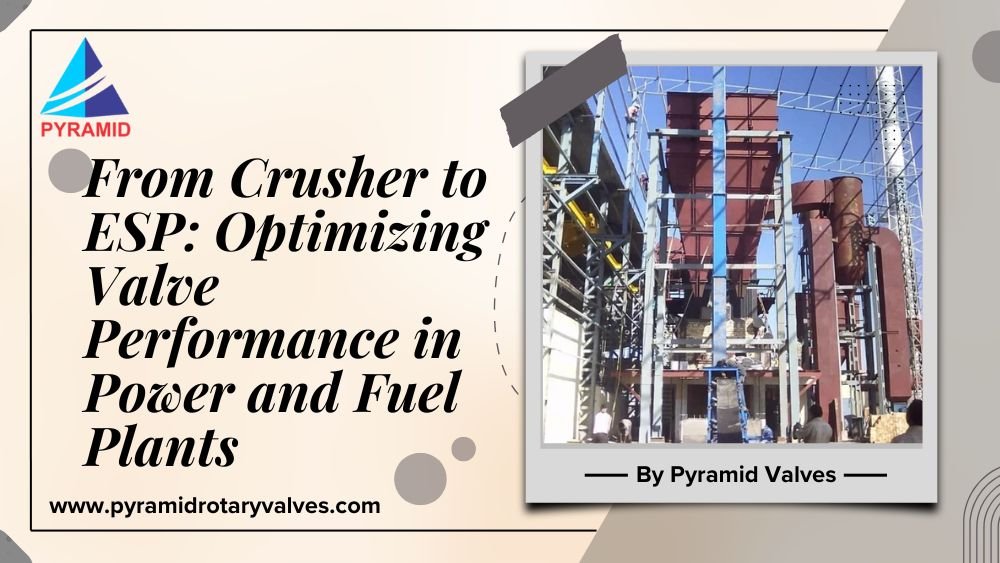
In an industrial facility, material flow is only as reliable as its weakest link. Within a heavy-duty Coal Handling Plant, materials undergo massive transformations—moving from large chunks down to pulverized fuel, and finally to fine dust. Managing this flow requires a deep understanding of where a mechanical Rotary Valve is needed to isolate pressures and where it is needed to feed materials.
At Shree Techno Engineers, we build the Pyramid range of valves to bridge these processing gaps, ensuring your system maintains peak volumetric efficiency from raw material intake to emissions control.
1. Surviving the Impact Under a Coal Crusher
The environment directly beneath a Coal Crusher is one of the most brutal zones in a Fuel Handling Plant. The material is highly irregular, abrasive, and drops with significant gravitational impact.
The Challenge: Standard feeders will crack or jam when large chunks of crushed coal impact the rotor pockets.
The Solution: For this application, Shree Techno Engineers provides heavy-duty, fabricated Mild Steel valves. These units feature reinforced housing walls and customized rotor designs that can withstand shock loading while maintaining a consistent feed to the boilers.
2. Maintaining the Pressure Seal in an Ash Handling System
Once the fuel is burned, managing the residual byproduct requires a totally different technical approach. In an Ash Handling System, the material transitions from coarse bottom ash to microscopic fly ash.
The Challenge: Fine ash acts like fine sandpaper, quickly eroding the internal tolerances of a standard Rotary Airlock Valve.
The Solution: We implement Cast Iron housing builds combined with internal Hard Chrome Plating. This preserves the critical 0.004″ clearance required to prevent air from leaking back up into your collection hoppers.
3. The Critical Role of the ESP Rotary Valve
The Electrostatic Precipitator (ESP) is your plant’s final defense against particulate emissions. The dust collected in the ESP hoppers must be discharged continuously without breaking the negative pressure vacuum of the system.
The ESP Environment: An ESP Rotary Valve operates under high temperatures and extremely fine dust conditions. If the valve leaks air, the upward draft will re-entrain the collected fly ash back into the gas stream, ruining the ESP’s efficiency.
The Pyramid Build: Our specialized ESP feeders are equipped with an 8-vane labyrinth rotor and air-purged shaft seals. This design ensures that fine ash cannot escape into the atmosphere and ambient air cannot disrupt the precipitator’s vacuum.
Application Matrix
| Process Location | Key Equipment Involved | Recommended Valve Configuration | Primary Objective |
| Crusher Discharge | Coal Crusher | Fabricated MS / Heavy-Duty Shaft | Impact & Shock Resistance |
| Boiler Feeding | Fuel Handling Plant | SS 316 / Beveled Vanes | Corrosion & Jam Prevention |
| Emissions Control | ESP Rotary Valve | Cast Iron / 8-Vane Labyrinth | Vacuum Isolation |
Conclusion: System-Wide Reliability
Whether you are managing a raw bulk line or a high-precision pollution control system, your choice of equipment matters. Shree Techno Engineers designs the Pyramid line not as standalone products, but as integral solutions engineered to maximize the efficiency of your complete processing lifecycle.
Are your ESP hoppers experiencing material bridging or air leakage?
Contact Shree Techno Engineers today to discuss upgrading your system with a precision-engineered Rotary Airlock Valve designed for your plant's exact technical demands.
Contact Now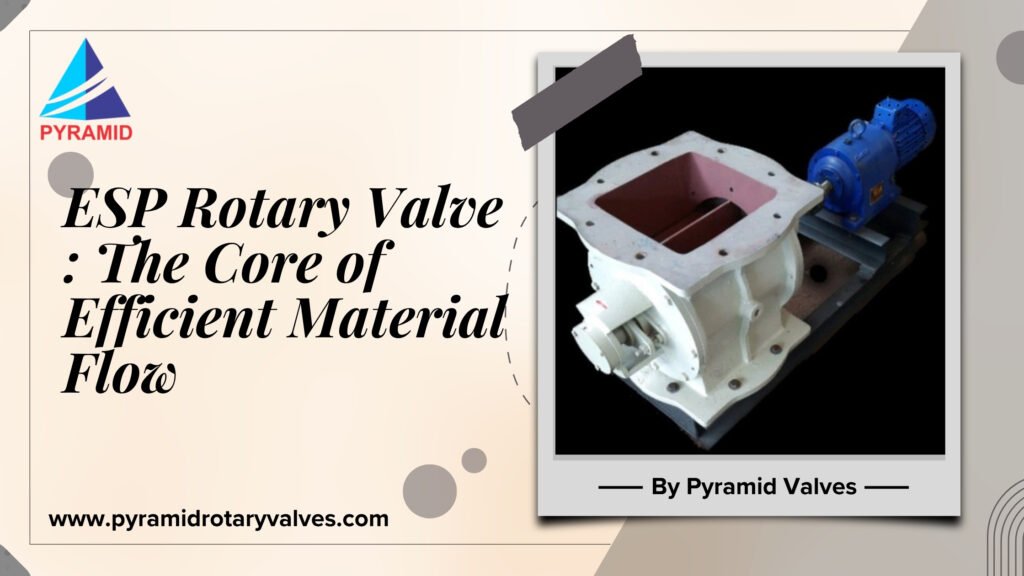
 Users Today : 4
 Users This Month : 212
 Total views : 4634