
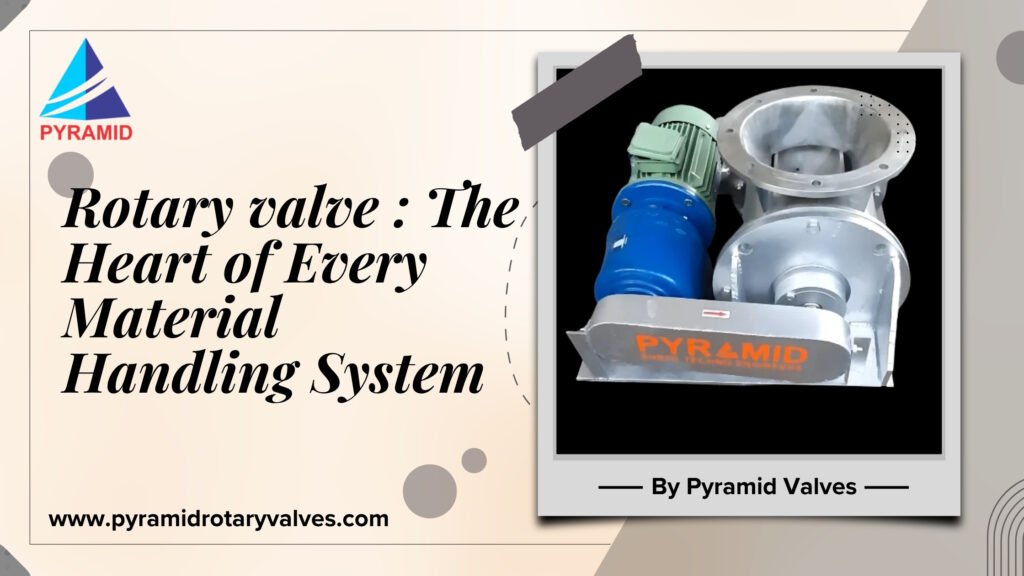
In industries where powders, granules, or bulk solids are handled such as food, chemical, cement, or pharmaceuticals the rotary valve is one of the most critical components. Though small in size compared to large silos or conveying lines, its job is monumental.A rotary valve ensures controlled feeding, airlock sealing, and pressure balancing between two different zones typically between a hopper and a pneumatic conveying line. Without it, maintaining consistent material flow and air pressure balance would be almost impossible.At Shree Techno Engineers, we design and manufacture precision-engineered rotary airlock valves that deliver reliability, accuracy, and durability for every industry need.
What is a Rotary Valve?
A rotary valve, also called a rotary airlock or rotary feeder, is a mechanical device used to regulate the flow of bulk materials from one chamber to another while maintaining an airlock.It consists of a rotor with multiple vanes (or blades) that rotates inside a cylindrical housing. As the rotor turns, material trapped in each vane pocket is transferred from the inlet (top) to the outlet (bottom), while the valve body seals the pressure difference.This mechanism makes rotary valves perfect for pneumatic conveying systems, dust collection setups, and hopper discharges.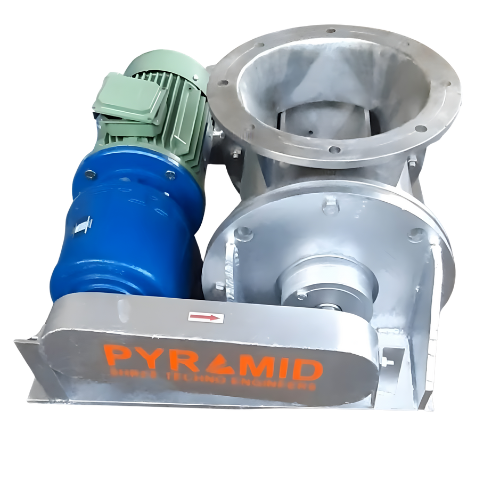
How Rotary Valves Work?
The working principle of a rotary valve is straightforward but precise.Material Entry :
Bulk material falls into the valve’s inlet under gravity or pressure.Pocket Filling :
The rotor pockets fill with a fixed volume of material.Rotation and Airlock :
The rotor turns, carrying material to the discharge side while maintaining a tight air seal.Discharge:
Material exits through the outlet, entering the next stage of the process. The entire process ensures a steady flow rate and prevents air leakage, which is critical for pneumatic systems.Types of Rotary Valves :
Pyramid Rotary Valves offers a wide range of models tailored to your process needs:1. Drop-Through Rotary Valves :
Ideal for general applications where material simply drops through the valve. Common in food, feed, and plastic industries.2. Blow-Through Rotary Valves :
Used in pneumatic conveying lines where material is directly introduced into the airstream. Excellent for fine powders like flour, cement, or starch.3. High-Pressure Rotary Airlock Valves:
Built for conveying systems with higher pressure differentials. Used in chemical, cement, and power plants.4. Sanitary Rotary Valves:
Specially designed for food, dairy, and pharmaceutical industries where hygiene and easy cleaning are top priorities.5. Heavy-Duty Rotary Valves:
Constructed with reinforced housing and abrasion-resistant coatings for highly abrasive materials like clinker, fly ash, or minerals.Key Benefits of Using Rotary Valves :
- Consistent Material Flow: Provides uniform feeding and discharge rates.
- Airlock Efficiency: Maintains pressure balance in pneumatic systems.
- Reduced Material Loss: Prevents backflow or air leakage.
- Energy Efficiency: Optimized design minimizes power consumption.
- Customizable: Available in various materials like cast iron, stainless steel, or special alloys.
Applications Across Industries :
Rotary valves are extremely versatile and used in countless sectors:- Food & Dairy: Handling flour, sugar, grains, and powders.
- Cement & Minerals: Feeding cement dust, fly ash, and limestone.
- Chemical & Pharma: Metering powders and granules with high accuracy.
- Plastic & Polymer: Conveying plastic pellets and resins.
- Power Plants: Transferring ash, dust, and fine particles.
Why Choose Pyramid Rotary Valves?
At Pyramid Rotary Valves, we combine engineering expertise, ISO-certified quality, and custom manufacturing to deliver world-class solutions.- Precision Engineering: CNC-machined housings and rotors for perfect clearances.
- Material Versatility: Stainless steel, mild steel, or special alloys for any process environment.
- Testing & Quality: Each valve is tested for leakage, capacity, and performance.
- Global Standards: Designed to meet international performance and hygiene standards.
- Customization: Size, drive type, and sealing options made to order.
Maintenance Tips for Rotary Valves :
- Regularly check for rotor wear and housing clearance.
- Keep seals lubricated and inspect for leakage.
- Use genuine spare parts to maintain performance.
- Schedule preventive maintenance to extend lifespan.
- Proper care ensures uninterrupted operation and long service life for your rotary valves.
 Users Today : 5
 Users This Month : 208
 Total views : 4626